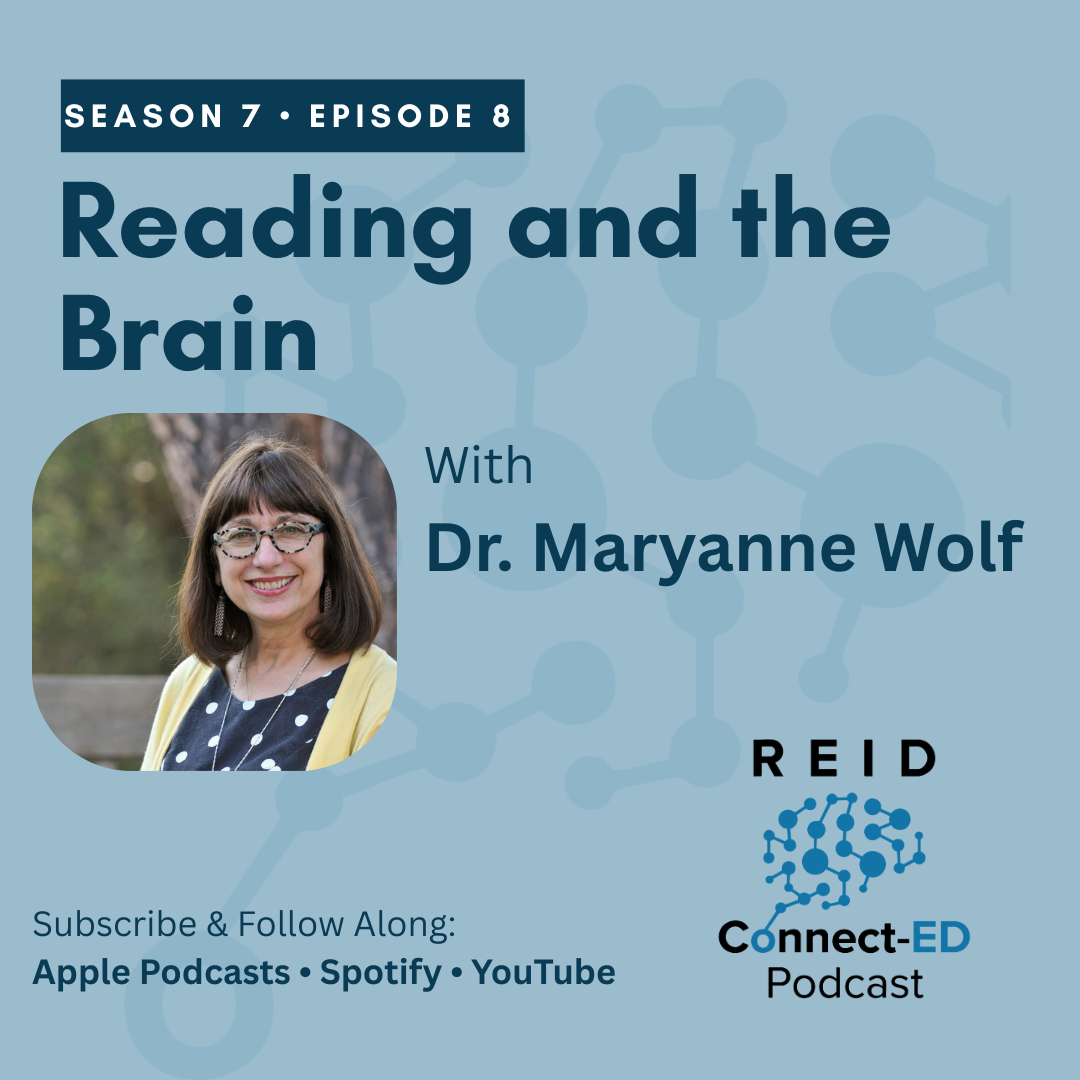
S7 E9: Reading and the Brain w/Dr. Maryanne Wolf
Listen Now!
-
Dr. Maryanna Wolf is a scholar, a teacher, and an advocate for children and literacy around the world. She is the Director of the newly created Center for Dyslexia, Diverse Learners, and Social Justice at the UCLA Graduate School of Education and Information Studies. Previously, she was the John DiBiaggio Professor of Citizenship and Public Service and Director of the Center for Reading and Language Research in the Eliot-Pearson Department of Child Study and Human Development at Tufts University. Dr. Wolf obtained her doctoral degree in Human Development and Psychology at Harvard University. She is the author of Proust and the Squid: The Story and Science of the Reading Brain (2007, HarperCollins), Dyslexia, Fluency, and the Brain (Edited; York, 2001), Tales of Literacy for the 21st Century (2016, Oxford University Press), and Reader, Come Home: The Reading Brain in a Digital World (August, 2018, HarperCollins).
Dr. Wolf’s website
Dr. Wolf’s books
https://www.maryannewolf.com/books-1
Dr. Wolf’s article
https://www.shankerinstitute.org/issues/literacy/elbow-room
The Scent of Time: A Philosophical Essay on the Art of Lingering 1st Edition, by Byung-Chul Han
https://www.amazon.com/Scent-Time-Philosophical-Essay-Lingering/dp/1509516050
-
Reading is an ‘invention’ in the sense that humans are not hard wired for reading and writing the way we are for oral language. It requires skill development and a new brain circuit had to be developed that was built upon older, genetically predisposed brain circuits. However, that brain circuit can change by our behaviors.
Numeracy and reading is only 6,000 years ago, which is not much within the history of our species. But there is a genetically predisposed ability in our brain to make NEW connections among old parts within our brain, which allowed for us to develop the ability to read. This brain plasticity implies that, depending on the language, there can be slightly different circuits in the brain. For example, more visual representation in east Asian languages compared to sound-focused languages.
Since there is brain plasticity, it can lead the brain’s reading circuit that is developed to actually change as we change the way we are reading (e.g., digitally versus on paper).
The reading circuit begins with the attentional circuit; different attentional systems. Then, it connects with the visual system and the language system.
As a child’s brain matures along with reading more sophisticated text, the circuit becomes more elaborate and complex. The cognitive, linguistic, and affective processes connect together.
Human beings are constantly connecting and making associations between what we already know with what we are reading in a moment. So we are constantly making judgments of what we are reading either supporting or not supporting what we already know.
With analog (paper) reading, we have time to activate inference. For instance, “what is the importance of what I already know and what the author of this writing wants me to think.” Inference is the ability to figure out “what is the intention of the material.”
Inference by reading analog allows for empathy in perspective-taking. Not just cognitive empathy (understanding another’s view) but also affective empathy (feeling another’s feelings). This is the foundation of deep reading. It allows us to think critically. Ultimately leading to an evaluation of truth. This is especially important in the age of AI, where otherwise you outsource thinking to another entity that ‘knows more than you know’ whereby you could not evaluate others’ information without critical thinking.
Deep reading requires time, not skimming. Digital platforms for reading encourage skimming and ‘moving along.’
Proust said we go beyond the wisdom of the author to discover our own. Dr. Wolf calls this the ‘reading ‘sanctuary ’. There will be implications for not diving into this deep reading and critical thinking that comes from it.
Alexis points out how even relationships have become more surface level and lacking critical thought and perspective-taking. Gerald points out ‘until they come to therapy’ and go in more depth of dialogue and perspective-taking.
The whole brain is functioning in unison across areas, not just in isolation.
Byung-Chul Han in his book “The Scent of Time” suggests we have become so accelerated in our relationship with the world; so busy moving from one stimulus to the next that we don’t linger between our perceptions of the world. In so doing, we have lost the contemplative. We have lost the stillness. In doing so, we have lost the ability to perceive reality in the moment itself. He wishes we could think of God as the God of stillness - the contemplative capacity that we possess but do not use.
By increasing how often we are outsourcing (e.g., with AI) and being less present in deep reading (i.e., the less we make efforts for reading), we are allowing our reading brain circuitry to be reconfigured and even lose memory. The reading brain circuitry gets lost and atrophies over time, as that circuitry is not hardwired, it requires use and practice.
Noveslit Jane Smiley was asked if the novel will die and replied that it will be ‘sidelined’ via the crisis of reading. Without reading, we may lose leadership required to respect the lives of others. Noveslit Marilyn Robinson also stated the biggest threat to democracy is to call another person the ‘enemy’. Two novelists talk about society resting on empathy.
Alexis shared a story of her client. She was able to have such a deep sense of empathy after reading someone else’s story mostly by being able to take the other person’s perspective via deeper reading.
Reading and deep reading is deep thinking. Similar to John Warner's book “More than Words” Dr. Wolf talks about cognitive patience. Proust reminds us that reading is in solitude but we are not alone because we are with the author.
Gerald talks about how therapy slows life down and how his patients have reflected on how therapy allows them to think more deeply and insights and ideas come naturally as they get more in touch with their inner nature. This slower deeper process is similar to the process of reading.
Dr. Wolf talks about how an Italian novelist Italo Calvino how writing takes an extraordinary effort to use a single word or phrase that captures the exact thought of the person. The screenwriter tries to capture that to see and hear the monologues in the expression. Good writers gives precise articulation of thought. At the same time, reading gives you a chance to go back and pause.
Comprehension monitoring involves spatial capacities that are being used while reading, which are not being used while watching a screen which basically involves just tracking the objects on the screen. While reading, there is a spatial representation of time and space that is used in your imagination and can be manipulated and reflected upon. As such, print gives you the most opportunities to conserve in memory. Films are now being made to be fast paced and stimulating, which is the antithesis of this.
Dr. Wolf has been invested in learning about Korean culture. In the television series, the scenes and plot and character development is all elongated, compared to western fast paced film scenes.
In an accelerated culture, we do not use time that is in front of us. Time is constantly on the move. This was said by Hong Beung Chen.
Alexis talks about the use of audio for those with Dyslexia and also paired with text to assist in engaging with text. Also, having familiarity and background knowledge provided it can help as an on-ramp to begin engagement with text.
Alexis shares how difficult it is to sit with what is in front of us when we get so used to reacting to all the notifications and alerts around us and on our phones. It takes time to encode and hold in memory information presented to us.
Reading involves sequence and detail.
Researchers in the European E-Read Network did a meta-analysis of 5p studies (over 171,000 subjects) to compare comprehension from print versus a laptop/computer, as well as with handheld devices. Sequence and detail was recalled much more when reading in print. Digital reading encourages skimming. Participants said they thought they were better at retaining from a screen even though it was not accurate.
Dr. Sherry Turkle from MIT often says we are not opposed to technology, so long as the negative impact (including that which may not even be predicted) is considered thoughtfully. Like how an Internal Review Board (IRB) asks researchers if there may be risks for a study on participants. Technology is not using this framework.
Someone from Microsoft years ago talked about continuous partial attention as a consequence of technology. We are losing the ability to see something and think at the same time.
Nuance lies below the surface and is needed to be inferred. Nuance and beauty require a level of perception that is impossible if skimming. Nuance is required for career skills, as well, beyond just learning protocols.
Our thoughts will change but at this point, researchers call upon us to have digital wisdom to understand technology impact on human users.
Large grants have been needed for Dr. Wolf to study the science of reading.
Phonics approach is foundational and important. However, a multi-component intervention is emerging as essential. Phonics and phoneme awareness is useful especially when connected to the somatic networks and meaning-making centers of the brain - connecting to stories, and over time involves the deeper reading processes.
Dr. Wolf developed the RAVE-O program while at Tufts, which had great results in her research in Boston.
Reading skill development needs to involve integration. Research is showing that this is better than phonics only approach, while phonics only approach is better than expecting the kids to just induce alphabetical principles on their own.
60% of kids, Jean Shaw, said they will learn to read but 40% and depending on your neighborhood may not pick up reading without this type of intervention to develop reading capacities.
RAVE-O provides print material and gives the teacher the ability for differentiation. The characters help the reading lessons happen in fun and meaningful ways.
Technology changes the brain, its not just a tool. Its about the wise use of technology.
Every child can be encouraged to love reading even if they don't understand the words. Just associating the love and joy of being read to is an emotional bond and connection. The child will develop language from being read to, as well.
Dr. Wolf and her colleagues in the Boston area studied music usage in the classroom and found that kids at the end of the 1st grade did better with reading than kids without music instruction. Rhythm in music is the time between notes just like the time between phonemes.
The science of reading cannot be narrowly defined or based on a checklist.
Knowledge plus flexibility is necessary to meet the needs of each individual. This is the same as in psychotherapy, as Gerald pointed out.
Dr. Wolf encourages others to be who they are even when society is giving toward AI information. Never forget our shared humanity. Read anyway and respect the integrity of others.
-
Gerald Reid 00:00
Reid, welcome back to season seven of the Reid connected podcast co hosted by myself, licensed psychologist Dr Gerald Reid and my sister educational therapist Alexis Reid, today, we are honored to have with us, Dr Mary Ann Wolf, one of the leading experts on reading and literacy, to educate us on the history neuroscience and instruction of reading with a focus on the science of reading and dyslexia.
Alexis Reid 00:34
So our relationship with reading as human beings is quite complex. You may expect that reading just comes online for children at a certain age, or that certain learners are either good readers or not. However, there's so much more to developing this intricate neural circuitry than just that reading must be explicitly taught, modeled, nurtured and supported as the ability to make meaning from our interactions with text develops the information and stories we consume develop our brains in expansive ways as a society. Some may think that reading is an important rite of passage and skill to learn and practice, and others might be noticing a trend that reading might not be as popular as it has been in the past on social media. You may see, or at least I do, reading enthusiasts or celebrities like Ryan Holiday, Reese Witherspoon, or our friend and musician and former podcast guest Shane Sager, showcasing the allure and joy of reading, there seems to be a movement to return to more analog approaches to accessing stories and information. However, in 2025 YouGov had a poll that revealed that while 60% of American adults read at least one book, 40% reported that they didn't read a single book all year. Is reading becoming an antiquated approach to engage with information? What is our role in the battle to bring back reading. Researchers around the world have been showing scientific evidence about the importance of developing regions of the brain related to reading, because strengthening these networks also helps us become critical and deep thinkers. Problem solvers, strengthens sustained attention, elicits creativity, pattern recognition, comprehension skills helps us gain new perspectives and even build empathy, just to name a few, with assistive technologies and innovations in science based approaches to creating access to text, learners have options for immersing themselves in literature, stories, poems and information, especially for young people learning to read, we adults play an important role in how the development of and love for reading unfolds. Our guest today happens to be one of the leading experts in the science of reading. She's a renowned cognitive neuroscientist, scholar and advocate for children's literacy, best known for her research on the reading brain, dyslexia and the impact of digital technology on reading.
Gerald Reid 03:08
With us today is Dr Mary Ann Wolf. She's a scholar, a teacher and an advocate for children and literacy around the world. She is the director of the newly created center for dyslexia, diverse learners and social justice at the UCLA Graduate School of Education and Information Studies. Previously, she was at the John di biaggio Professor of citizenship and public service and Director of the Center for reading and language research in the Elliot Pearson Department of Child Study and Human Development at Tufts University. Dr Wolfe attained her doctoral degree in Human Development and psychology at Harvard University. She is the author of many books, including Proust and the squid, the story and science of the reading brain, dyslexia, fluency and the brain, as well as reader come home, the reading brain in a digital world. Welcome to the Reid connected podcast, and we're so happy and honored to have you today, and we just love the energy that you're bringing to the podcast today.
Maryanne Wolf 04:07
Oh, what fun it is to be with you, both Jerry and Alexis, and it's a joy to be back in Boston. I have to say, I love the fact that I left 80 degrees when I came to zero degrees in New England, but I truly miss the spirit here. So it's, it's truly my pleasure to be with you both, and you're doing such good work that how could I say no? Thank you. I hope the hot tea warms you up. I need it.
Gerald Reid 04:34
Well, one of the things that I want to bring up is there's a quote in your book, and it just totally blew my mind. You know, this is not a topic especially well versed in, but your book, you said reading is the single most remarkable human invention that you've come across. And I kept thinking, invention. She's using the word INVENTION about reading. That's fascinating.
Maryanne Wolf 04:55
Oh, Gerald, you are actually coming close to the first sit. Sentence in Proust and the squid, and it is we were never born to read. And just as Alexis hinted at in her introduction, and what you're really pulling from me is the fact that reading, literacy itself, numeracy, these are not things that are genetically programmed in our brain, language, vision, cognition, all of that's a genetic program. You put a child anywhere, and they will develop those. And so people think that because oral language is natural and genetically endowed and will just unfold that reading written languages, it's anything but the case. And the reality is that our brain for any cognitive invention, it could be knitting or bicycle riding, any invention requires a new circuit, but complex inventions like reading and numeracy require complex connections among parts that are developing genetically. So what's fascinating to me is that reading is is is something new for the species. Numeracy and reading are new. When we think of how old our brains are, we're really talking about something that began more or less 6000 years ago. That's nothing in the species history. But there is something that the brain does have that is genetically endowed, that allows reading and that it it has this almost semi miraculous ability to make new connections among old parts. I mean, when I think about all of us getting older, wouldn't that be nice, generally, to have that principle be ours? Well, okay, but it is a species gift that we as a species can make new connections for new inventions, which is why, when we look at reading, we look at both very positive aspects, that it could exist, but the slightly negative is that it will change because it's plastic. So the invention itself determines the beginning, beginnings that elaborate over time. But the plasticity means, depending on the language, you will have slightly different circuits. The circuit for reading will be sharing similar components like vision and language and cognition and affect very important to always add affect. But the reality is, Chinese or Japanese kanji will require more visual real estate, if you will. So you will have much more going on in parts of the brain for visual memory, for a Chinese or Japanese kanji than you have in English, but an alphabet will require much more of the phonological the sound system, so you're going to have similarities and differences. But I will add a third element to our story that we will be talking about today, and and Alexis hinted at it. We're changing, and we're changing in reading because that circuit is going to be matching or reflecting the characteristics of the medium it's reading upon. So we read differently on papyrus, but we read differently on an iPad. We read very much more differently on a laptop than we do a book. Can you explain what you mean by we read differently we read we have that same circuit. Now here, actually, I'm going to use Alexis work on executive processing here, because I know a lot of your listeners are more familiar with the fact that attention is one of the most important aspects for any cognitive skill. What do we give attention to? What is the relationship between attention and memory. Well, I'm going to get too fast into complexity here, so I'm going to say it in as simple way as possible, and then we'll get more complex over time. But the reality is, where we have this very beautiful circuit for reading that begins with attention, our different attentional systems, we have to let go. You know, we have to inhibit what came behind. So what all the Alexis talks is about in executive processing, we are using those skills in reading at the beginning to set it up. And when you set it up for print or for anything with reading, it begins.
Maryanne Wolf 10:00
Of course, it goes through all this visual system connecting to language. Now here's the beauty of print. Attention when you have time, goes to not what we just call comprehension, but to what I call deep reading processes. This gets really it's beautiful, actually. But you know, the first the first child, is connecting their their letters and their sounds to meaning, and that's great. But as that child gets older and the circuit begins to elaborate with ever more sophisticated things that they're reading, the sophistication of our cognitive, linguistic and affective processes get hooked up to that circuit. That's gorgeous, but now with print, you have the time to attend to analogical thinking. Now, what the heck is that? Well, you know this, but a lot of the world doesn't. Every human being is making analogies between what they know already and what's in front of them. In reading, we're making a beautiful connection with what is that reading changing and what we know? Does it support it? Is it different? Well, in making that decision when we are reading in print, we have time. This is the important point. We have time to activate inference. What's what is really the import of this connection between what I know and what the author of that other perspective wants me to think inference is not just mystery writing, it's an ability to figure out what is the intention of the material. Now that brings us to something that is so often neglected when we talk about comprehension. Alexis, you and Jerry know all this, but I want the world to know that one of the most important aspects is
Maryanne Wolf 12:08
empathy, the ability to leave your perspective. Those of you who know your Piaget, you are moving from an egocentric perspective into thinking about what the other thinks and feels. Now in a novel, it can be not only what that character is like, what their character thinks and feels. It gives you a whole new perspective from another human, another historical epoch, another religion, you are passing over. You are passing over, leaving your perspective, taking on two forms of empathy. Now this is where your question is really
Maryanne Wolf 12:50
landing us into the middle of the reading brain circuit, because it's not just one form of empathy, which is, do we feel something? No, it is. It is a combination of Machiavelli and Charlotte's Web. Yeah, and I really mean this because Machiavelli was in the prince is really teaching us how when we think about others, we are thinking about what they think. So cognitive empathy is our ability to take on the thoughts of the author, the thoughts of the other, or as affective empathy, literally our whole our limbic system we are we are beginning to learn how to feel what others feel, whether we call that compassion or empathy. It is an inordinately important and too often neglected aspect of deep reading. Now, before you tell me the next question, that's just the beginning of the deep reading processes that then come all together, always interactive. Everything is interactive. Coming here, going there, it contributes to our ability to think critically. So when we think critically, we're not just thinking, we're thinking, we're feeling, we're making inference, and we're making an evaluation of truth. Here's where
Maryanne Wolf 14:18
the ability to evaluate Truth has never been more important. In the era of chat, GPT or Claude or anybody else where you think, because you have outsourced and they know more than you do, you could not evaluate without this developing critical thinking. Now the reason why the medium is important is about time.
Maryanne Wolf 14:46
The attention to all of these deep reading processes requires time. What we have done is become skimmers. So the medium has these characteristics that i.
Maryanne Wolf 15:00
Actually encourage, and a set, a psychological set, towards getting moving along, moving along, moving along. And so we end up skimming the surface of the information, and don't necessarily, unless we are really trying hard, we don't necessarily go into those deep reading processes. Now there's one more, and I'll end this section. But this, this, this part of our talk sets us up for understanding the reading brain circuit. That's what comes out of your question. What is happening? You have all these things, these deep reading processes, and if you have really learned how to do this,
Maryanne Wolf 15:45
it opens you up to I call it the reading sanctuary. Proust called it the place where we go beyond the wisdom of the author to discover our own that is the reading brain circuitry that we either use because our attention gives us the time to do this, or we simply have enough attention to get the gist of it, and there will be implications aplenty. So your one question I used, the audience says it knows this. You cannot believe the list of questions that this wonderful man gave me, so I am trying to put about four responses in one, lest you be with me till your supper time.
Alexis Reid 16:33
So beautifully integrated. It makes me think of so many things. First of all, this idea of skimming and being so surface level and and it's a shame that I feel most relationships in life are really just on the surface lately, right? And it's it's very interesting. I never thought about how we are skimming the surface of what we're reading, and we're also not like opening ourselves up to the vulnerability and the potential connection of really get to know, like, what's underneath the surface of people we interact till they come to therapy, until they come to therapy, probably, yeah, therapy is a good way to leave yourself. Yeah. It's a great point, yeah. But you know, and also to this emotional side of reading and developing reading in our brains. David Rowe is our friend and colleague.
Alexis Reid 17:25
He always says that learning, teaching and learning is so emotional, it is right and and if we lose that aspect of the process, we lose this deeper sense of learning and developing the circuitry in our brains. And I just want to make one other note, because I'm sure you have a lot of things to say just about that alone. But if for the UDL enthusiasts who think about how the principles are set up with different regions of the brain, you made such an important point, that our whole brain is connected, yes and firing across dimensions. It's not just happening in one place. And this is why, especially in UDL terms, we think about the affective network absolutely to be able to be engaged and motivated and connected to the learning. And I see this so often with young people. Yes, you know, across the lifespan, to be quite honest, from from very young learners all the way up to college and graduate age if they don't see the connection, the purpose, the why, of what they're engaging with, it's very difficult for them to have more than that surface level of interaction with what they're learning.
Maryanne Wolf 18:36
You have, I've got about three or four things I want to say. I'll try to restrict them to two. One is the quickest, because it it never occurred to me until a very, very intelligent young person came to me and said, I read your book. I felt like it was talking to me, because I have become a skimmer, he said, but I never realize it bleeds over to my relationships. Wow, just like what you said. And I had never thought of that Alexis ever. And he made me, he said, really? I just, I just skim across my relationships, and and, and I, he said, and he even went to this, he said, including my sexuality, I'm like, Oh my goodness. What. What a thought that I have never had in myself. But of course, that is what reading does in and of itself. It generates, you know, your insights go beyond the author. Well, he went way beyond me in this understanding that he had become a skimmer of life. There's a Korean philosopher who lives in Berlin, and his name is Han Byung Chul, and he wrote, he writes many books, but he wrote a book called The scent, the smell.
Maryanne Wolf 20:00
Now the scent of time in which he said we have become so accelerated in our relationship to the world, to almost all these different aspects. He didn't use the word skin, but he used psychological and philosophical terms to say that we are so busy move moving from one stimulus to the next, whether it's in reading or or how we are with people, or, you know what, we're in life, that we don't linger. And he uses the term linger, we don't linger between our perceptions of the world, and in so doing, we have lost the contemplative. We have lost the stillness. And he said, he went on to say something beautiful. He said, I wish we could think about God as the God of stillness, the God who gives us the contemplative capacity that we possess but don't use. And it's not a catch phrase, it's something deeper than that, so beautiful, much deeper than that. And I hope people actually that will book was more than 10 years ago. He's written even books on hyper culture. But it's that principle that we do not linger, and therefore we do not perceive reality at that moment and and I, he's never heard of me. He will, you know, no matter how I will try to write him, he doesn't answer anybody, or he certainly doesn't answer me.
Maryanne Wolf 21:34
But I hope someday to meet him to say
Maryanne Wolf 21:38
the reading brain supports everything that you are writing philosophically and that in an age of AI, where not that the the if you will, we have used our natural tendency to want to be efficient. We have replaced effort and thought with the desire for efficiency, and in so doing, the very effort that literally builds the circuitry elaborates the reading brain circuitry is lost. It's becoming atrophying over time. So the more we outsource, the more rely on other, the less we make the efforts that go into. I go back to Alexis and memory. We do not have the same memory. Yeah, so this is what, but I have one last thing that you I cannot not say it because it's about empathy, and what you said, part of my life is science, and the other part is literature, and I will never forget the author, Jane smiley, the novelist who was asked whether the novel is going to die. And she said, No, I do not believe it'll die, but it will be sidelined, and when it's sidelined, which is what is you're saying about the crises of reading, not just the United States. One book. We're lucky. Our students are not reading one book in high school. That's college after college. We're finding this out, not one single book. But what she said was, when we don't have people who read books, when we don't have leaders who don't read books, they will fail to develop the empathy necessary to lead a people who respect the lives of others. Wow. And then the other novelist who comment was Marilyn Robinson in a interview with Barack Obama, and he called her the ambassador of empathy, or something like that. And she said the greatest threat to democracy is the tendency to call others the enemy.
Maryanne Wolf 24:15
So here you have two novelists who are talking about the absolute importance of empathy, not just for the individual, but for the society and for the leaders of society and for democracy itself, if you do not respect and give dignity to the perspectives of others, but call them enemy because they don't agree with you, you will lose the very essence of a democratic society. So here's where deep reading and democracy just come right together. I think you know, humanity is also in there too. Absolutely we're losing pieces of human.
Alexis Reid 25:00
Humanity and you know, one of the things that I do like about digital technology and the interconnectedness that we're able to see and learn from others is that like this, right? We're not just in our own communities anymore. We get to see outside, but we have to choose to interact and learn from others, but in literature, in stories, in interviews that you read or interact with, newspaper articles, we get to see different parts of humanity that we might not see or interact with every day, and this is where, you know, gaining differences in perspective or learning empathy or even relating to an experience a character, or even, like, tangentially, something that a character has experienced, yes, is so valuable and important. And I was thinking about you yesterday, not just in preparation for today, but also a college student of mine. We were talking about reading, and she said, you know, in my classes, I'm just kind of skimming through the readings because I show up for class and I don't really need them to be prepared, because the teacher is just teaching and talking at me instead of the contribution of our intellectual wisdom and collaboration. And she said, You know, I was thinking about how in high school I read this book, and it was about an African American who was telling his story, and I was so moved by it, because it's so different from my life. And she said, you know, it was, it was it resonated so deeply. And I felt such empathy out of compassion, but also out of, like, being able to understand, yes, somebody so so different than her. And it was such a beautiful moment. And it was ironic that it happened this week, because I was gonna see you today, but it was just it reinvigorated my enthusiasm and excitement for young people's wanting for these experiences that I think sometimes gets lost. So, you know, young people sometimes get a bad rap.
Alexis Reid 27:03
We're constantly Jerry and I are constantly trying to bring forth these really intimate, beautiful conversations we have the privilege of having in our practices and getting to know young people on a different level. But there's this wanting for these experiences. And in your book, two quick things I'll say. One is, if you are a skimmer and you're reading, reader come home, do not end in the middle. Please keep going. Because I found, I actually found myself wanting and waiting for the contemplative part, yes, and it comes at the end. Spoiler alert, but I was true. I was really, you know, I was waiting for it, and I knew it was coming, and I just sat with it and it just, it kind of like, came over me, yeah, and just felt like a big hug and remembrance and reminders of the importance of kind of like, again, like, like I'm saying, just sitting with what you're reading and thinking about how it makes sense in your life. And honestly, this is what this podcast is about. It's kind of, we call it like an all a cart situation, like, pick and choose what you think might be helpful for you to learn about, yeah, and see how it relates to your own life and see what to do next from there. But the book was so beautiful in that way. And I just, I think it's so important for us to slow down. And I'm guilty of this too. We, I think we all are. I've been, I'm glad you share that story of the the author you just mentioned. Forgive me. Jane smiley, Marilyn Robinson, Korean, oh, you're hung by Yeah. Because I've been, I've been really fascinated. And I certainly don't know enough about it, but I've been really fascinated with Japanese culture and wabi sabi, this idea of perfectly imperfect, yes, and remembering that the seasons are meant to kind of like, give us pause to check in and move forward. And in your book, you say, I think one of the most beautiful things going back to harkening back to your studies as a literature student, and thinking about how libraries and books, if we go back to them, it's like visiting our friends. They are visiting different parts of our life. It's true, and it reminds me of in one of my favorite movies, almost famous, when they say, you know, you could put on a record and hang out with your friends. And I thought the same about your reminder of this. And I think we lose all of these beautiful parts of reading and, to be honest, of humanity and life in the rush of just doing more and pushing further. And you know, anyways,
Maryanne Wolf 29:40
I'll just say one thing that I'm going to ask Jerry for a question. I'm going to turn the tables on him, but I have to tell you a little tiny back story on what you just said. I wanted that last letter these books is full of it's an epistolary book. It's like. Letters, because in 2018 we were on the threshold of understanding. I think now we understand so much more about what digital culture does. But I made the letter so that people would take their knowledge base just like what we're saying about analogy, you know, to to, this is my knowledge base. This is, these are my conclusions. I did not realize those conclusions, or predictions, if you will, would be so supported by the evidence, but the last letter, what you said, was the most important to me, and the there was a moment when the editors said, don't use we don't want the last letter, because we want the reader just to take it off and do do their own contemporary I said, you know, the most important thing for me is to actually meet that reader as fully as I can. And the last chapter, the last letter is my effort to say you are my good reader. If you've lasted to the ninth chapter or letter, you are my good reader. And these are my best thoughts to give you for your best thoughts. And the whole book requires something. It's so curious. You said, Don't scam the whole book requires a term that not everyone has ever heard of. I invented it in a certain sense, but it's what we all possess, and that is, there is, there is a quality of what I call cognitive patience. I love that that allows us to linger with a thought. And reading is thought. Reading deep. Reading is deep, thinking, deep writing, the work of John Warner these days, it's a book called more than words, and it's about what it takes for us to get to the point where we have slowed ourselves down enough to reach what I call this sanctuary. This actually Gish Jen uses the term the place of interiority. She's a dear friend and novelist. She the place of interiority where we can use that cognitive patience to get there, but we can use it to linger there and just stay with our thoughts and actually not be lonely.
Maryanne Wolf 32:36
You know, there's such loneliness in our culture, and that's where we know that other people who we are reading about have had the same thoughts, or worse thoughts, worse experience, better experiences, but others and we will and actually, that is what I keep coming back To Proust. He said, reading is that fertile, fertile miracle of communication that takes place in the midst of solitude, and here we are totally alone when we really read that level. And we aren't alone, we're with that author's thoughts, even if that author died 500 years ago, there is something of a connection. And so now that is my segue to turn to Cherry and say in your practice. Do you how do you feel that my worries about society actually being more and more unconnected to each other. Do you feel that in your practice? Does, does your does your practice reflect that? How talk to me about my worries about connections?
Gerald Reid 33:53
Well, I wanted to use one of my questions that I'm allowed to ask you, but I'll save it for later, because I know I have a quota. But you know, the way to answer that question is, when we slow things down in therapy, which I think is essentially what happens in therapy, everything becomes slower. And people who have reflected back on their work with me, they would say, you didn't tell me what to do. You helped me to discover myself. And to me, that is the base. The best gift any therapist can give to someone is helping someone to kind of rediscover their true nature and their authentic self and understand their patterns and and then decide what to do with that. And usually people make pretty, you know, healthy decisions once they go through that process. But I think that people often will say things like, Oh, I never thought of that. Oh, wow. That just popped in my head for the first time. Yeah, so I think it reflects everything that you're saying. I'll save my question. I'll turn into a comment that I was going to ask you before, but you know, I'm comparing and contrasting Reid. And deep reading to looking on a screen or watching a show or binge watching a show or watching a movie. And what you said is sounds really important, is that when you read, you have time to think, and when you have time to think, you can actually imagine. What was that person thinking when you're watching a reel on Instagram or a TV show or movie, people are talking, and I was thinking about this, like, a month ago, I was watching a movie. I'm like, It's funny how, like, movies find a way to have people say such precise things that people don't really say in real life, in like, the precise moment. Like, everything is like, it's like, oh, we're trying to understand where what they're thinking because there's no thought bubble. There's no There's no, like, inner monolog that you get in movies, that you would get in reading where you can stop and think, Oh, what is that person thinking? What's their inner monolog? You don't get that in movies or in video. And so it's funny how movies always try to almost try to, like, correct for that by having them say the perfect thing precisely that reflects their inner monolog. But it's still not enough to truly as you're saying, pause and say, Wait, what is that person thinking and what is their inner monolog that's written on this page? Because, you know, books will have inner monolog that's, I don't know
Maryanne Wolf 36:10
that's a whole different there's a wonderful line from the Italian novelist Italo Calvino, that writing requires this extraordinary, arduous effort to find the most used, the perfect single word that will capture the thought. And when you're writing, you are actually pushed by seeing it there. You're pushed to write again, to find the ever more perfect, ever more precise, precise articulation of your inner thoughts. And so writing gives you that and that person, the screenwriter, hopes to actually capture that so that you could see and hear the monolog from the expressions and but reading gives you a chance to think about it. And film is evanescent. And I love film. I love I relax at night from all kinds of ways. But I find good writers of series, and I'll follow the writer, because just of what you're saying. A good writer gives me that precise articulation of thought, but reading gives you something that, and even though I will always want film, always want the visual and as and the audio, all this is so important, but reading gives you a chance to go back. And there's something in in the science of reading called comprehension monitoring, and it means that you you don't even know, but you actually have spatial skills capacities when you're reading that you don't know. They are useless. On a screen, there's no spatial on a screen. You have an evanescent entity that is constantly moving, and you're moving with it. But when you're reading, you control time and space. Oh, fascinating. And you can go back and people ask me, little what? When you said this and I'm saying, okay, back about a third away through lower, probably the bottom of the page on the left. Now I'm I can do that for books, and there's no perception that I have of it. But is this you you do not realize you have a tactile, haptic and spatial aspect to reading that print gives you and helps memory. Actually, it helps memory, yeah, but you don't do that with the screen and so, and you also don't do it with audio. I prefer you know when, if you have a Goldilocks effect, the Goldilocks is print, next is audio, next is Kindle, next is iPad, and then next is your laptop, because it's all about attention, distraction. As you go up the line, you know, the more distraction possible, the less likely you can get to deep reading and understand what you might miss. So in that whole line of different mediums, the one with the print gives you the most opportunities for the most ways to conserve in memory. Yeah. So real quick, I just want to make this point is that I heard in relation to what you're saying, is that movies are now being made where things have to move quickly in order to maintain people's attention. Is the distraction, yeah, the age of a distraction. So to your point, you can't, kind of, I mean, first of all, you can't go back and, like, kind of reread and, like, contemplate so much to what you're saying. But, yeah, so it's. Kind of the opposite of what you're saying is take your time and then digest what's going on and put yourself in their shoes, and don't just move on to the next scene, because you're not going to be able to truly digest that one scene. And you, you will have such differences in cultures. And I, I've been reading, not just reading Han by young Chul, the Korean philosopher. But I've been very invested in understanding Korean culture. I just went there, actually, I went there to worry about the fact they're digitizing kids materials from third grade on. And I'm saying, No, don't do this. So, but, but I, but I watch what are called Korean dramas, or I'm very interested in Japanese and Chinese, but what happens in those series is so different from an American series, just as what you're saying. This is not true across the board. This is women the there are certain writers I really appreciate. But it'll it's elongated. It things don't just happen. I mean, just think of how relationships in American movies. Yeah, it's it's completely different. I joke with my sister, who really is an expert in all of this. And I say, you know, Karen, it takes 10 episodes before the protagonist kisses. I think about that all the time. Really amazing to me that you have such a different relationship to time inside relationship in different cultures. And so your your comment is, is a beautiful one, because I think we have lost in and what Han Byung shell said, in an accelerated culture, we have lost our ability to use time in front of us. It's constantly on the move in an accelerated period we don't have. And goes back to cognitive patients, and then in reading, you don't have time now audio. I want to rescue audio, especially with dyslexia. My son, who's dyslexic, has only read my books through audio, right, right, you know, and so I very much appreciate what audio can do. But by and large, the monitoring of comprehension isn't going to happen. You can rewind, but you don't.
Alexis Reid 42:27
So I just don't, yeah, and I Well, first of all, I I'm a big fan of teaming audio with a print text for me interesting. I find it really helpful. It guides and helps me prioritize where I want to pause. It helps me hear and see at the same time. But I will say, you know, we always go back to the context. Depending on the context, a different scaffold or support might be necessary to even engage in the text. And in this age of AI with, especially with executive function challenges that I primarily work with, I find that a lot of young people just aren't even engaging in text. So my entry point is, hey, can we find a summary first to have a context, a foundation to work from, because this idea, and the thing I love about reading too, is that there is this idea of sequence and predictability. So if you have something to be working from familiarity with the vocabulary and the characters, it's an on ramp to be able to engage in a story or a text and, you know, audio using the screens, I think the biggest fear for me with using screens as I sit with an iPad in my lap is going back to what you were saying before about attention and executive systems, that our brains have a very difficult time filtering out extraneous information sensorily, like when we have access to different things, or if we're used to responding quickly to every notification, flashing light or thing that comes into our purview. It's very difficult just to sit with what's in front of us, right? And I think that, you know, like you said, it impacts memory. It impacts so many things. And I have conversations every day where students are like, well, I read this book. Oh, yeah. And I'm like, Well, tell me about it. What did you think about this aspect of so and so's, you know, life, or the plot, or when this happened and and they have a very difficult time retrieving. So I'm constantly, I do a lot of psycho education with the people I work with and the educators, especially that. You know, we need time to pause and encode what we're reading instead of just moving on. And I think, I think that's the fear with digital text, right? Of course, from with my accessibility background and friends, they would be very angry if I didn't talk about the importance and value of having digital access, because there are Some learners who absolutely need it, and we want to build skills across the board. It's the same with AI, right? As I mentioned, I have a lot of reservations about AI. We have a whole episode on the ethics of AI, but also thinking about how it is supportive and sometimes necessary for people, especially with disabilities, to access or to start, but I always say it's an on ramp. It is not necessarily everything, and we need to build these cognitive skills. Otherwise we're losing so much.
Maryanne Wolf 45:32
So again, you have both of you keep having these sparkling activation periods where I'm thinking, Oh, stop, let me put it on a finger to remember to comment, because you've got so many things that make me very excited. But let me just, let me just mention two of them. So one is, you referred to sequence and detail, and one of the major studies that are is going on, right? Well, these are researchers in what's called the European e Reid network, and Megan in Norway, selmaran in Barcelona. They do what are called meta analyzes, which you know, but your listener might know, they put together 50 studies of over 171,000 subjects, and they asked the question, what is comprehension like for the same story on a computer, laptop or print? And they have done this in 2018 and 2024 with handheld devices. That was the newer one. But what they find is that, by and large, the comprehension questions about sequence and detail, there's no way the people who are using a laptop are able to recall that no interest. So their ability to gather sequence is because, I mean, they're skimming right. And then there's the second part of that one study was so salmaron's group did the big meta analysis, and then an Israeli researcher asked the question to these digital natives, what do you think you're better at? And they say, Well, we know we're better in the screen. And she says, why? And they said, well, because we're faster. So this, this great error in society that that thinks that speed is the equivalent of either memory or intelligence or comprehension is completely false when it comes to reading. It's not that you don't have to have fluency. I even wrote a book for God's sake or just like the Influency, but you absolutely have to be able to have time to think and the skimming mode that is encouraged intrinsically by the affordances of screens, this is a problem now. I don't want to be neglecting what Sherry Turkle, who's across the Charles, said years ago, and I quote her all the time, because it's so right. It's not that we're opposed to technology or to innovation for heaven's sakes, but what we are opposed to is when you innovate without asking what it will disrupt or diminish unintended consequences Exactly. And these are not only unintended, they are none unthought of. They didn't try to think. And that's what I My message to the tech, the world of technology. And my, my one son is an artist, and my other son has worked for Google for nine years. I said, you know, is just, you know, we're talking about the ethics of AI. We have, as a society, a responsibility to ask what an IRB asks researchers, yes, what deal? What will the consequences be for your subjects? At what expense? At what expense, what are they? What is the impact? And so technology has gone for all these last years ahead with the assumption that they're doing I and I give you know I really want to give credit with the assumption that innovation will advance society. I think that was especially in the beginning, out of an altruistic belief in technology. But now we have all this evidence, especially in the last 10 years, that our children, especially, are being affected in negative ways in the development of language and attention because, Jerry, of that distraction that you were talking about earlier. Linda, I'm blanking Linda's last name, from Microsoft, 20 years ago, used the term continuous partial attention as one of the problems that she saw for Children. This is the problem for everyone. We all have continuous partial attention. And I look and I think we can't waste quote, a minute without our cell phone, but what is it doing to our brain's capacity? Just as you asked me the question about film, we have lost the capacity to actually see things and think about them in time. We're moving, moving, moving.
Gerald Reid 50:30
So how important is? Is nuance as a human being in context?
Maryanne Wolf 50:36
You know, Nuance needs to be inferred. Nuance doesn't lie on the surface. Nuance lies below the surface to be interpreted and found and discovered. [I wasn't expecting that. That's a nice answer.] Well, you asked me a good question, and I hope to respond with a good answer, because and it's almost as to go back to nuance. There is nuance in your question, and so I really believe, like Marilyn Robinson and David Brooks, actually something goes missing. Beauty goes missing, said David Brooks and Marilyn Robinson said Beauty is part of what is in written language to be discovered to add to the experience of the reader. And so I would say that nuance and beauty require a level of perception that is impossible if you're skimming yeah and so important for professions where people may not even realize it's going to help them in their future careers. That's right. I can train therapists to know how to do CBT, but yeah, if there's no nuance to what they're doing, yeah, you know. And it doesn't mean you don't want CBT, exactly right, and this is the way I feel about technology. It's not that I don't want technology. I want technology. Why do we have the opportunity, three of us, to meet and give away our best thoughts this moment? Right? This moment, our thoughts will change, and they do change, but this moment, we have to have what I call, not, in fact, other researchers have called it. It's not my term, but Digital Wisdom. We and Digital Wisdom takes some effort and time on the part of the innovators. So I turn to them. As I said, my one son, I work for Google, and my daughter in law, all of these. One daughter in law is, you know, is it Yale and act and really trying to figure a lot of philosophical and very practical questions, and the others practical questions in technology, they're both really doing service that will help us answer questions from two different, very different perspectives. But I believe it's only when we are trying hard to figure out what Sherry Turkle said, what will it disrupt? What will it diminish? What will it atrophy?
Alexis Reid 53:18
I think we also need to bring folks who are going to be users into the room, yes, especially those who have disabilities who rely on these technologies. Yes, to have these conversations. You know, our great friend and colleague, Dr Luis Perez from CAST Yes, speaks a lot about this. He is a user of digital technologies because his sight and vision has diminished over the years, and it's it's a different perspective than I can ever imagine, as thoughtful as I can be, as I'm creating or assisting, I can't live that experience and to bring folks into the room who struggle with reading, especially, you know, I always say I learn more from the students I work with than I do from the books I read. Yeah, because asking them the questions, getting curious and learning more about their experience, and letting them articulate, that becomes therapeutic, actually, for them to share. Sure, and it's and it's brilliant, and I, you know, I'm cognizant of time, and I don't want to lose two really important things I know we want to talk about. I want us to think about I mentioned before. Educators and caregivers, parents alike, often struggle to understand the nuance, the value, the importance of really high quality reading instruction. And there's an article, what was it, Jerry in the Times or the Wall Street Journal you sent to Jillian and I maybe a year ago. Yeah, I can't remember. It was about the science of reading. Jerry sent it to myself with Emily Hanford, perhaps about that, yes, and a great friend of mine, Jillian Lopez is a, is a OG expert, wonderful as she does. I want to give her a lot of credit to it. And Jerry sent it to us and goes. Wait a Minute educators don't know about the science of reading. He was like, in shock. So I wonder if there's like, you know, we don't have time to go into all of it. I wish we did. Please pick up Dr Wolf's books to learn more. But what are some, like, really important aspects that you think listeners should know,
Maryanne Wolf 55:21
I think the first and I really what I will do. I don't know, with your podcast, I could give them access to an article that I just wrote for Albert Shea, wonderful. Maybe that would be a good way of doing it. And it actually connects to this whole idea of what is best for, especially with UDL, for heaven's sakes each individual with their particular strengths and particular weaknesses. Now you recall that my I said that my son, Ben, who is this amazing artist? Oh my goodness, I'm so proud of him. But he did not he was not easy. He was so dyslexic. Is So dyslexic, and I learned how he thought, how he reacted, and how he dealt with failure. And it was so important for him to teach me years ago, the beauty and importance of engagement, and he was taught, I won't say where, and by said, but by a person who was really what was then called and still called whole language. And the idea that was then that and still is that, that the alphabetic principle is best induced by the reader, by them having experiences with good books. And over time they would get it. They would make the Helen Keller epiphany on their own. That was the induction now balanced literacy, especially in the beginning, said, Well, maybe we can help it a little with with, you know, some attention to letter, sound, correspondence rules, but it really wasn't systematic at all. Now, the science of reading is actually many disciplines coming together, especially over, I would say more 50 years, but most people are thinking 20 years. But it's when people actually like me at Tufts were given very large grants from the National Institute for Child Health and Human Development, especially under men named Reid Lyon and they're Brett Miller. Now all these wonderful people were saying, Put your money where your mouth is, in terms, especially in my area with my colleagues Robin Morris and Maureen Lovett, we wanted to say we can do better. How can we take the information we have from cognitive science, in my case, cognitive neuroscience, and apply it to the building of interventions? Now those interventions are certainly based on the alphabetic principle, and that is, let's say, a phonics approach is one of the major pieces. But goes beyond that, and I'm going to use a term that most people in the science of reading are only now beginning to hear. It's called multi component intervention. So of course, we put a lot of emphasis on the phonics principles of making sure the child knows these letter sound correspondence rules. But unlike a lot of these programs that call themselves science of reading, they actually only are doing phonics and phonemes or phoneme awareness. They are not connecting it to meaning, to affect, to what I would call the rest of the language systems. Wow. So I have been trying to have people use the acronym possum, so they think phonology, certainly orthography, the PO, is like every phonics approach, but that it is never not connected to the semantic networks. I'm not talking about vocabulary list. You know, 10 words at the end of a week that you spell and you learn, no what are the words that are connected? I'm smiling because when I was in the classroom, that's what I did. This is so important, the POS and then you're connecting it to syntax, so we use the same words. Now I'm talking about a program that was invented at Tufts called ravo, and we now have recreated it in the last three years, so it's much longer, but we tested it in Boston, and we have the best results in the world. But anyway, and I actually that was when we first met years and I integrated into my work too at this, this, you see, this is the word integration. So we integrate all these phonics principles, all these phone rooms, but with meaning. We with syntax. With morphology, no one used to know what the smallest unit of meaning a morpheme everybody thinks, even some people gave me, I'm not kidding, bumper stickers that say morphemes are sexy. It was such a gift that was we might have to bring this, but the possum is like expanded understanding of the science. This was science, but you see, Possum is another way of saying the foundational skills are bigger than phonics. And so a lot of the people who love stories and books should feel at home learning about this because it's to be immediately connected to story. So this multi component instruction is integrating all of Possum with stories. We call them minute stories that, then over time, incorporate the deep reading processes I was just going to add. And I was like, you probably already have this integrated but you know, thinking about smaller chunks of reading exactly allow for and to kind of guide that process, pause Absolutely. Yeah, we believe that deep reading begins at the start. So this is an approach that we have in Revo a colleague, Maureen Lovett. But what the intervention data this is, you know, now I'm going to talk about just one minute, our data show that this approach is better than a phonics only approach, and certainly the phonics only approach is better than thinking that the kids are going to induce the alphabetic principle on their own. So 40% of our kids are not going to induce it. 60% of the kids, no matter what Gene Shaw said this, no matter what you get, they're going to learn but 40% and depending on your neighborhood, wow, I can predict what's going to happen by your zip code. That is wrong. We have equity issues all over the place. But I want to say one last thing, the technology that is so helpful when used correctly. We, in our new ravo are even our old ravo had something called Speed wizards. What we are doing is we are giving the teacher everything organized in a digital portal so she or he, it's all there differentiation for this child. You just look it up every single day. The script is there every single thing, but the material for the child is print. And then when they need work on fluency, we do have a game that engages them and helps them practice. My colleague, Glenn Miller, used to do all this in Boston years ago to work on it. Stephanie got vault all these wonderful, oh my god, the people who in Boston who helped Reid incredible. You know, they are just so beautiful. And I'll never forget, the mayor of Malden asked us to bring this program to his summer school. He did not use his budget for his carpeting. He used his carpet budget to bring ravo to Malden. Now I, you know, I hope you're still around somewhere. Maybe I'm not. I'm sure he's not the mayor anymore, but priorities. But this was, you know, what I'm saying is, technology is not the enemy, nor is it, however, only a tool. It changes the brain. That's the point. You have to have technological wisdom. That's where UDL has been from the start, brilliant. It's matching. It's the match. What is the wise use of technology and the integration in the design.
Alexis Reid 1:03:44
There's so many educators that do a beautiful job of proactively, anticipating the news and building it in from the beginning, into the environment, rather than as an extra That's right, right? Rather than saying, integrate student might need audio books, so we'll bring it in just for that one student. It becomes a part of the culture which helps to understand variability, and it goes back to understanding different perspectives and approaches. But I really appreciate all of this on so many levels, and I'm curious to know more about what else are you currently working on right now?
Maryanne Wolf 1:04:22
Well, we when we realized that ravo was only for one year, and that was insufficient for me to really bring in our work on deep reading, we have changed it so that we're working to have a three year program so we really go after empathy, critical thinking, inference, but in the most fun way, I would, I would, there's a little girl named Magnolia, and I've never, ever realized how important the characters, if you remember, there's ms, Mim, okay. I'm just gonna tell you about one character, actually two characters, and then I'll stop really. Like a spider web, too, characters that go along that spider web is where you put all the meanings of words, right? So, Ms Mim, and I will confess to the world I lay I was trying to say, what if Bette Midler could be this amazing spiderweb? All these things, big eyelashes, you know, big smiley face. And Ms MIM stands for many interesting meanings. Now, linguistics, that's polysemy, right? But the reality is that so many of the primer words, oh and Melissa Orkin is doing all this training in Boston, I should remember, because she, she, they talk about ms MIM all the time, but Ms MIM teaches children that the words could have as many meaning as she has legs. Oh, wow. So you have a word like bat, you you have. You have syntax, you have. Well, anyway, so Ms MIM Magnolia imitates Miss Mim, and then she imitates Mayor Mick, who is me, interested me now, he has an afro, and she is this little Howie girl in Hawaii, and she's imitating. And I'm thinking, this is reading. This is reading because she she's dyslexic. She hated what was happening in the public school, and she went to this school for dyslexia and by and large, I thought, Okay, our job is to engage attention so that they will end up loving reading, no matter how hard it is, that they will love it. So all these characters, I just want to say for the educators out there too, because I hear this too often from a lot of young people I work with, and even older people looking back on their lives, and they say distinctly, I can remember the time where teacher would sit with me and I'd be doing my reading assessment, and they expected nothing of me, and I felt the energy from them just knowing that I couldn't get through it. Yeah. And years later, this is what they remember. Yeah, the day I'm like, tearing up thinking about it, but just like that story just is such a beautiful contrast to the experience of a lot of struggling readers and learners, and not just with dyslexia. And we this is a whole podcast for another time, but the overlaps between ADHD and dyslexia and reading challenges are huge. They are so big, and it's leaving a lot of educators and parents kind of lost because they're not sure what to do. I would argue, and in my experience, and we could talk about this forever too, I would integrate similar practices as I learned from ravo, into across honestly, across the grade levels. It wasn't just for younger learners, and I would use that as my entry point, yeah, to excite learners about beauty of words, exactly, a courtship with language. Absolutely, it's so lovely. Said,
Alexis Reid 1:07:56
I love that, but it's, you know, I just, I just want to share with the folks up there, you know, we're grateful for all the work everybody is doing, everybody because it's so complex, you know, and there's so many aspects of things. But one of the things that really moved me was, from your books, your writing, your work over the years, is the importance of being excited about reading exactly and even at the simplistic level, right? Sharing your love of it. It becomes infectious.
Maryanne Wolf 1:08:24
Yeah, and every every child can begin at six months to love reading, even though you don't have they don't have a clue. And parents say they don't understand the thing I say, That's not what's important. They're going to start loving being with you, loving them and reading and they hear your voice, and over time, they're going to learn words they never could have imagined, because the world of books gives them not just words, but concepts that go with words. It's a beautiful it's the most beautiful, inexpensive way to introduce a child to the love of the world. It's a beautiful thing. And I remember you saying that, or maybe it was in the book, but like, it's a emotional bond. It is between a parent or caregiver and a child. And when, when I heard that, I was like, Oh, my God, that's so true. It's like, it's an association, yes, and not only exactly it. And as you said, it's not only good for language development, and it's really important cognitively to be read to. It's important for the cognitive element, but it's an emotional almost like a nostalgic memory that could be a positive one, that could, you know, and if you are going to be dyslexic, as my son was, and one of the people who worked, who works now in curious learning, and sends tablets around the world and and is teaching, is teaching literacy to in Africa all Anyway, she's amazing, Stephanie Gerald, but she once said to me that the kids who are read to who come to us at the clinic, when we had one at. Tufts, the ones who are read to, they're so much easier because they already love books. That's fascinating. They love books they've had. And when Stephanie said that, I thought, Oh, she's so right. So we're giving this connectivity. Now I have a grandchild, first grandchild, that child has I, you know, in all likelihood she's gonna be dyslexic, right? In all likelihood the genes are there. And what I love is that she now knows books so well. I showed her a little caterpillar in a book on a bullfrog, and she got up, she went to a bookshelf and pulled out very The Very Hungry Caterpillar. Wow, she'd already had an association. Now she has very little language like her father, by the way, it'll be fine. It'll be fine. I tell them, it'll be fine, but in all likelihood, she will be dyslexic, but she's already loving books. That's amazing. And so this what we want every child to have. And the parent who is not necessarily fully literate, they can make up, make up those words given them in Spanish or Portuguese or Korean or Chinese, whatever it is. But this love that you're taught, you said, the emotional bond. Give it to them.
Gerald Reid 1:11:21
I love that.
Alexis Reid 1:11:23
You know, again, we can go off and talk about this for a whole separate episode. Maybe one day we will. But you know, even if, if reading is tricky, or if your English is not your first language, and you're trying to work with your child learning English, you know, music and song is another way to build pattern recognition and rhythm and prosody and so much that can translate so beautifully to reading too well.
Maryanne Wolf 1:11:50
I think she's setting me up, Jerry, don't you think before we begin? And I've learned, but the reality is very serious. And we did a study in Boston. Kathy Moritz did this, and then ani Patel at Tufts, and Ole Ola, who's not bu ozernov palchik, did all these music studies. Very basically, we looked at one charter school that used music, and they used the Suzuki method for kindergartners. And had, you know, music every day. And another charter school that was not devoted to music. And I think, you know, those horrible older books. They whatever it was, I can't remember it was, but they had music a little bit once a week. That was it. So we then compared everything else, the same neighborhood, all these things. Kathy Morris, I wish she was here, she would laugh. We really had to work hard to match. And the kids at the end of first grade who'd had the music did better. And and then Ola and Ani Patel did all these studies, and they're showing that what's really going on is rhythm. Rhythm is, remember rhythm is, if you think about the time between phonemes, rhythm in music, the time between notes and the time between phonemes is related. So you know what we're really and I just love ani Patel has written, you know, wrote a beautiful book on music and the brain, but he and OLED is very sophisticated. Now, what does that mean to our schools today that say, oh, we need 90 minutes of this, 90 minutes of that, so we can't I'm so sorry. We can't do music, or we can't do art, or we can't do sports, or we can't do recess. I say, please, I want you to just have this research. You keep music, you're gonna do better in music. Movement, movement, oh, my god, reset. It activates our brains in ways that, oh my goodness. Isn't that fascinating that we grew up in a time when we had that, and now we've quote, unquote progressed as a society, and yet we don't have the things that we need that we had. Maybe we had, maybe we didn't realize why we needed it back then. We didn't know why. But was intuitive, well. But you know, those intuitions were based on a lot of good 19th century insights too. But then some of those insights were wrong, sure, sure, of course. And but leave it to the French. Was 18th century French. They gave phonics basically to the elite. Everybody else had to learn by induction on the Bible. No way, right? And so we, you know, this was this, this, this unnecessary, unnatural fight between whole language and balanced literacy and phonics. I really, you know, please, we the breeding brain can teach us that it is in this systematic, in explicit has to be explicit instruction, of all of this being integrated, that that's what the brain does, and that's what our teaching should do. But everybody needs. To learn a little bit more, and the science of reading cannot be so narrowly defined as phonics, or phonics plus phonemes, or make it a checklist. Oh my gosh, no. Checklists. Even though I'm an executive function person, I'm not a fan of checklists. This is what's happening. Oh, we did phonemes today, oh we did spelling on Friday. Oh we did morphemes in third grade,
Alexis Reid 1:15:21
going back to Jerry's favorite word, everything is so nuanced, right? And everybody different people might need different things at different times, and they do and we need to listen and we need to pay attention.
Gerald Reid 1:15:32
There's such an overlap with psychotherapy and how it helps people. And I was teaching my students in class, and one of my students gave this amazing presentation and outline of an article I gave them about how important integration of different theories is when you're working with someone, if you stick to one theory too much too rigidly, it actually doesn't help. It could be. It could backfire, and people may not benefit from therapy for not able to integrate different ideas and I and concepts. So there's, a there's an overlap in other fields as well, certainly, yeah.
Maryanne Wolf 1:16:03
And both fields need a flexible they need knowledge plus flexibility as it matches the individual. Need you know this. This is an equation if the numer if, if there's only one denominator that's not going to match every individual numerator
Gerald Reid 1:16:21
Exactly.
Alexis Reid 1:16:23
Well, we like to end each episode thinking about something you're hopeful for and maybe something you're grateful for, just to kind of wrap up. And I know we can again expand and extend this conversation, and I would love that, but in the interest of time with something that you're looking forward to and hopeful for?
Maryanne Wolf 1:16:44
You know, just even being back in Boston with the two of you is just a sign of hope. Talking to all of those I don't know, two 300 students at BU yesterday about how I want them to be them selves, not a chat GPT self. Know who you are and be that self. And so if you know my last question last night was, how can we hope when you know all of society is going a different way, I say you're the hope every single person has something that they can do to bring the world to a better place by never forgetting our humanity, a shared humanity, and reading no matter, even if it's on a medium that I don't necessarily like, read anyway, read anyway. Just leave yourself behind and respect the integrity of others and their viewpoints. So you know, may may your work here be multiplied. May it be multiplied. Oh, thank you so much, so beautiful. And I'm so grateful for you for the work that is that you've done that's influenced me and so many and all of the young people and learners whose lives it's touched. We're so grateful for your dedication and your passion and your incredibly intricate and precise and thoughtful work that you've done in the sciences. It is incredibly noticed, and we're so grateful for it. Thank you. Thank you so much. Spread it. Yes, spread it. Multiply.
Gerald Reid 1:18:25
I'm so grateful I get to meet you in person and really know your energy, because it's it's special and it's important,
Maryanne Wolf 1:18:33
and thank you for not asking me all the questions you had on that list.
Gerald Reid 1:18:38
I didn't ask one question my wonderful.
Alexis Reid 1:18:44
Thank you. Thank you.
Gerald Reid 1:18:59
Thanks for tuning in to the Reid Connect-ED podcast. Please remember that this is a podcast intended to educate and share ideas, but it is not a substitute for professional care that may be beneficial to you at different points of your life. If you are in need of support, please contact your primary care physician, local hospital, educational institution, or support staff at your place of employment to seek out referrals for what may be most helpful for you. ideas shared here have been shaped by many years of training, incredible mentors, research, theory, evidence based practices and our work with individuals over the years, but it's not intended to represent the opinions of those we work with or who we are affiliated with. The reconnected podcast is hosted by siblings Alexis Reid and Dr. Gerald Reid. Original music is written and recorded by Gerald Reid (www.Jerapy.com) recording was done by Cyber Sound Studios. If you want to follow along on this journey with us the Reid Connect-ED podcast. We'll be releasing new episodes every two weeks each season so please subscribe for updates and notifications. Feel free to also follow us on Instagram @ReidConnectEdPodcast that's @ReidconnectEdPodcast and Twitter @ReidconnectEd. We are grateful for you joining us and look forward to future episodes. In the meanwhile be curious, be open, and be well.
S7 E9: Reading and the Brain w/ Dr. Maryanne Wolf
In this episode, Alexis and Gerald were honored to be joined by Dr. Maryanne Wolf, one of the leading experts on the science of reading. Dr. Wolf shares a tremendous amount of knowledge and wisdom from her extensive career and experiences, as she continues to advocate for the needs of all students as it pertains to their development of and appreciation for reading.
This discussion brings to light so many questions about our relationship with reading. We address topics such as the evolutionary nature of reading, the impact of technology on our reading brains, the interconnectivity of brain areas related to reading, progressive and effective modes of reading instruction, Dyslexia, and how reading relates to humanity and our relationship with one another.
Summary
Evolutionary nature of reading
Understanding of how reading is learned
Impact of technology on our reading brains
The interconnectivity of brain areas related to reading
Effective modes of reading instruction
Connections between reading, empathy, & humanity
Be curious. Be Open. Be well.
The Reid Connect-Ed Podcast is hosted by Siblings, educational therapist, Alexis Reid, M.A. and licensed psychologist, Dr. Gerald Reid, produced by CyberSound Recording Studios, and original music is written and recorded by www.Jerapy.com
*Please note that different practitioners may have different opinions- this is our perspective and is intended to educate you on what may be possible.